

I have come to think of this moment as the great adaptation, a period when systems everywhere are under stress that technical fixes cannot resolve. Democratic institutions, organizations, communities and families are all confronting conditions their old ways of operating were not built to withstand.
Climate change is where I feel this most acutely. It presents a test, or perhaps an invitation, to change the way we see alongside the way we act. I have spent years inside this question, first tracking metrics and sitting in rooms with serious, committed people trying to move numbers. Gradually, I began to sense that something was incomplete about the frame I had accepted.
The shift was adaptive. It changed how I talk about climate work, the questions I ask and the work I take on. I have come to believe that lasting climate progress requires people willing to work at the edge of the accepted conversation, where established ways of seeing can be questioned and new ones can begin to emerge.
The Dominant Climate Story
Climate change is fundamentally framed as an emissions problem. Reduce carbon, stay within 1.5 degrees, reach net zero and life will be good. Progress is measured through parts per million and percentage reductions, with the atmosphere serving as an accounting ledger.
It is also framed as…
A technology problem -- Renewable energy, carbon capture, electric vehicles and smart grids will enable a cleaner future. Better engineering and faster deployment become the primary work.
A policy problem -- Carbon taxes, international agreements, regulatory frameworks and corporate pledges can create the incentives needed to shift behavior at scale.
A problem of urgency and political will -- We know what needs to happen. People just need to understand the stakes and summon the will to act.
Each of these frames captures something important. The emissions math is unforgiving, technology matters, policy matters, urgency is justified. Technical progress is indispensable, but it remains vulnerable unless people and institutions also undergo the adaptive change required to sustain it.
Charles Eisenstein’s Climate: A New Story argues that reducing climate change to a greenhouse gas problem leaves the deeper relationship untouched. Nature remains a collection of systems to be optimized. Human beings remain the engineers of planetary outcomes. We seek to reduce the damage without examining the way of seeing that continues to produce it.
The fragility of that arrangement is becoming increasingly visible.
For example, as the expansion of artificial intelligence has accelerated, Google and Microsoft have subordinated their climate commitments to the demands of growth. The Net-Zero Banking Alliance followed a related pattern. It once represented trillions of dollars in assets and public commitments from nearly 150 banks. After the 2024 election, a wave of withdrawals began as political pressure intensified. In October 2025, the alliance ceased operations.
These reversals reveal that the commitments were not strong enough culturally, politically or institutionally to survive competing priorities. My suspicion is that many were adopted as targets without becoming organizing commitments, principles capable of reshaping what an institution was willing to become or to sacrifice. They could guide action while the surrounding conditions remained favorable. They could not hold when growth, technological competition and political pressure demanded something else. A related pattern appears within the energy transition itself. Forests and wetlands have been cleared for renewable energy projects. Entire regions have been depleted to supply the materials those projects require.
Consider Ecuador’s Pastaza region. Balsa wood is used as a core material in wind turbine blades. During the surge in demand in 2020 and 2021, illegal loggers cut new roads into protected Indigenous territories, including areas deep within the Yasuní Biosphere Reserve, home to the Waorani people and one of the most biodiverse places on Earth. China purchases most of Ecuador’s balsa exports to support a wind energy boom celebrated elsewhere as green progress.
The technologies have changed, but the relationship often hasn’t. Nature remains a resource, a liability or an accounting category. Climate change is managed as a technical project while the deeper crisis in our relationship with the living world continues. If the dominant story cannot expand to meet that deeper crisis, leadership requires us to venture beyond it.
Dancing at the Edge
Many people have been approaching this deeper crisis beyond the boundaries of mainstream climate discourse.
Robin Wall Kimmerer, a botanist and member of the Citizen Potawatomi Nation, offers a different understanding of what progress requires. Her work asks us to consider what it means to belong to the land rather than own it, to participate in ecosystems rather than manage them and to receive gifts with an obligation to reciprocate.
At a session I facilitated, a room of corporate sustainability executives arrived expecting a familiar conversation about water quality metrics, turbidity standards, watershed management and regulatory compliance. Kelsey Leonard, a legal scholar and member of the Shinnecock Indian Nation known for her work on water rights and personhood, opened with an entirely different set of questions: Who is water? What does she dream of? Where is she going?
It was the first time I had allowed myself to take a group of corporate sustainability leaders that far beyond the accepted boundaries of their field. I didn’t know whether they would experience the questions as illuminating, irrelevant or evidence of my incompetence. Some people were unsettled. A few were moved.
Leonard’s questions were not poetic supplements to the technical conversation. They challenged the premise on which that conversation rested, the assumption that water is principally an object for humans to manage. My purpose wasn’t to persuade the group to adopt her worldview. It was to create enough space for the worldview already governing their work -- and circumscribing their freedom to act more courageously -- to become visible. Once visible, it could be examined.
This lineage runs deep. Wangari Maathai, the Kenyan Nobel laureate who founded the Green Belt Movement, understood that deforestation, poverty and the disempowerment of communities were inseparable. People in the movement she created planted trees as acts of ecological and political repair, rooted in the conviction that healthy land and human dignity belong together. Her daughter Wanjira continues this work through the Wangari Maathai Foundation and the World Resources Institute.
These perspectives are often described as coming from the edge. They are not inherently peripheral. They have been pushed to the margins by institutions that determine which forms of knowledge count, which questions are legitimate and whose understanding of the living world is treated as authoritative.
Leadership requires the capacity to work at that edge. The edge is where established explanations begin to break down and unfamiliar possibilities can be encountered. It is also where technical expertise credibility -- the very currency of many climate professionals -- becomes less secure. There is no consensus to provide cover.
Dancing at the edge means creating room for perspectives before the mainstream has validated them. It means staying present when a group becomes unsettled and resisting the urge to pull everyone back toward familiar ground. It requires enough conviction to take the risk and enough humility to remain uncertain about what will emerge.
The Great Adaptation
Building on Margaret Wheatley and Deborah Frieze’s understanding, I see climate progress as a journey of adaptive change. Adaptive change is required when progress depends on shifts in people’s values, beliefs and loyalties. New knowledge or technical expertise cannot produce those shifts by itself. People must confront what their current way of operating protects, what it costs and what they may need to relinquish.
As an established system reaches its limits, leadership begins with breaking ranks with the assumptions that hold it in place. From there, people can recast the work, mobilize others, help hospice what can no longer serve and create space for what is trying to emerge.
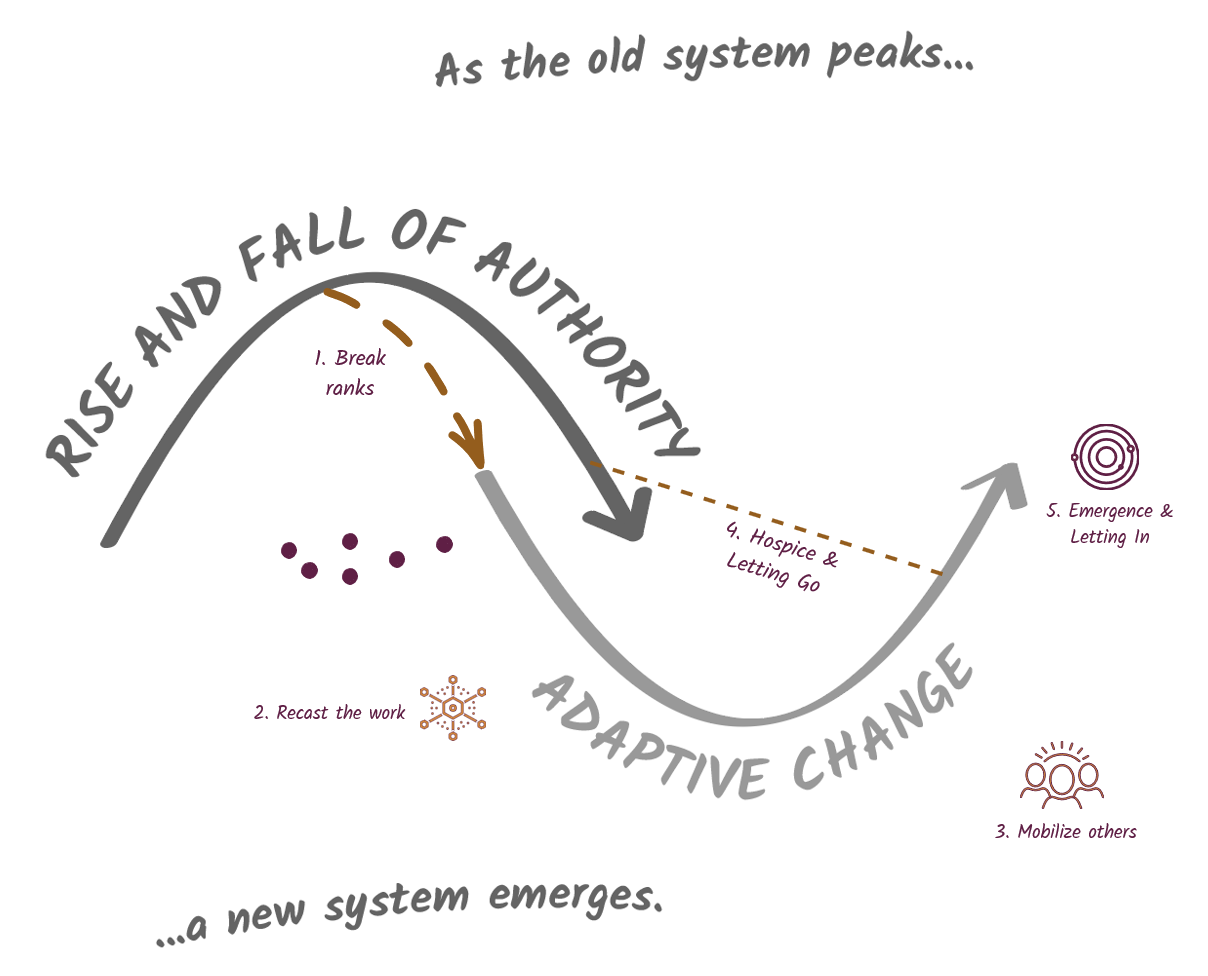
These five movements in the journey of change give this work a direction. Breaking ranks makes it possible to question the dominant frame. Recasting the work opens different ways of understanding what the crisis asks of us. Mobilizing others begins to shift what a group or institution can imagine together. Hospicing and emergence address the harder work of relinquishing what cannot continue while cultivating what is ready to take its place.
The journey is neither orderly nor assured. New possibilities begin taking shape while the old system still holds most of the authority. Working at that edge means moving toward something that cannot yet offer legitimacy, proof or protection. The risk is greatest when the established system remains powerful and the emerging one remains difficult to see.
Climate change is among the deepest adaptive challenges in human history. Reducing emissions calls for an underlying shift from separation toward participation and from management toward membership in the living world. That shift develops through experience, attention, conflict and loss. It takes root as people and institutions reconsider what they serve and what they are willing to sacrifice.
This helps explain why technical commitments can remain so vulnerable and incomplete. An institution can announce a target without changing the priorities that govern its decisions. It can deploy cleaner technology while preserving an extractive relationship with the places and people supplying it. It can speak the language of sustainability while treating climate goals as negotiable whenever they compete with growth.
Adaptive leadership creates the conditions in which those contradictions can be faced. It brings difficult questions into the room. It makes competing commitments visible. It protects unfamiliar voices long enough for people to hear what they are saying. It helps groups remain in the discomfort of discovery without rushing toward an answer they already know how to implement.
The question is whether we can reduce emissions, change policy and accelerate renewable energy without reproducing the relationship that created the crisis, one shaped by separation, control and limitless extraction. Climate change asks what we are prepared to build. The great adaptation asks who we want to become in service to life -- ours and the Earth's. They're inseparable.